Domed well cover from €690
The dome is the cover for wells that are meant to be seen: a rolled iron canopy crowning the coping the way a setting crowns a stone. It is the historic form — the one found on manor wells, fortified farms and village squares — and the most requested in the range.
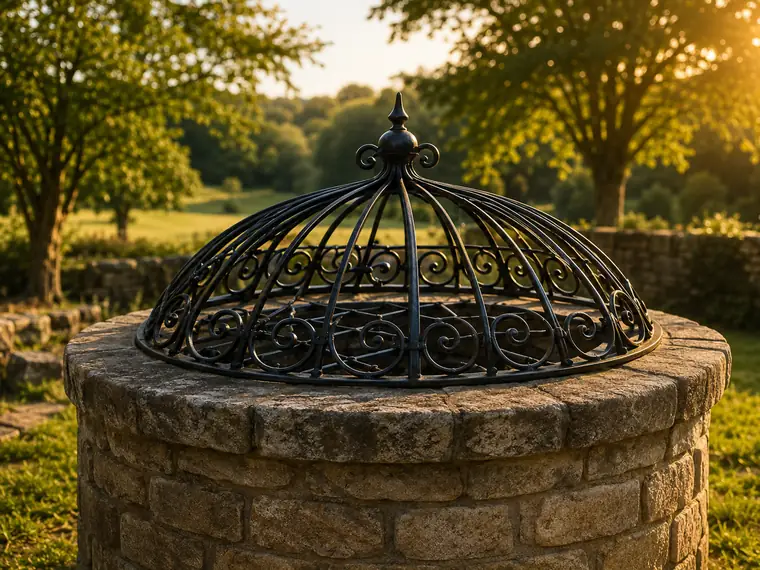
Sizes & prices — domed well cover
| Size | Supply price |
|---|---|
| ⌀ 80 cm | €690 |
| ⌀ 100 cm | €850 |
| ⌀ 120 cm | €1,010 |
| ⌀ 140 cm and over | €1,130 – 1,320 |
June 2026 prices, solid hot-dip galvanised iron, paint included, excluding fitting (€150 – 300). Source: Grille de Puits.
Prices exclude delivery. Delivery is carried out by us and is compulsory: a forged, hot-dip galvanised piece weighing 25 to 60 kg travels on a pallet, not through ordinary parcel post. The cost is quoted with the piece, according to postcode, weight and overall dimensions.
The historic form of the French well
The dome was never mere decoration: by doming the cover, the old smiths stopped loads being set down on it, shed leaves and snow, and cleared the volume the pulley needed. Our domes follow the same logic: main ribs in 30 × 10 mm flat bar crossing at the apex under a forged ball or pine cone, a lower crown rolled to the diameter of the coping, and — depending on the drawing — C-scrolls between the ribs, as on eighteenth-century work.
Three dome heights are offered: shallow (≈ 25 cm, understated), classic (≈ 40 cm) and cathedral (≈ 55 cm and above, for wide copings). Quoting is done from a photograph of your well: the dome must be proportionate to the height of the coping, and the workshop calculates that.
Design options
The dome lends itself to personalisation: ball, pine cone or fleur-de-lys at the apex; C- or S-scrolls between the ribs; a low frieze of ogees; and, for wells that still carry their headstock, a bespoke cut-out that encloses the original ironwork without touching it. If your well still has its pulley, say so on the quote request — we forge around it, never against it.
Finishes: matt black as standard, bronze green, walnut brown, or any RAL colour. On honey-coloured stone, patinated bronze green is by far the handsomest — the choice of eight clients in ten once they have seen the swatches.
Manufacture and guarantee
Like the rest of the range: solid iron only, full welds ground flush, hot-dip galvanising by immersion, then paint. The dome is the most exposed piece — rain, frost, full southern sun — and that is exactly why hollow tube is banned here: a tubular dome rusts from the inside within five winters. Ours is guaranteed twenty years, structure and galvanising.
Fitting a dome: a job for two
The dome is the model for which we most often recommend our own fitting service. Two reasons: the weight (30 to 60 kg depending on diameter, to be offered up without scratching the stone) and the centring of the dome, which must fall exactly in the middle of the coping or it will look askew. If you fit it yourself, plan on two people, a hammer drill and resin anchor. Offer it up dry, mark the four points, drill and blow the dust out thoroughly, inject the resin, pack it level and check the centring before final tightening. Illustrated instructions and stainless fixings are supplied. For a dome that has to accommodate an original pulley you want to keep, flag it on the quote: the workshop draws the opening around the existing ironwork and never touches it.
Domed well cover: your questions
Does the dome get in the way of drawing water?
Which dome height should I choose?
Can you reproduce the old cover from my well?
Worth comparing before you choose
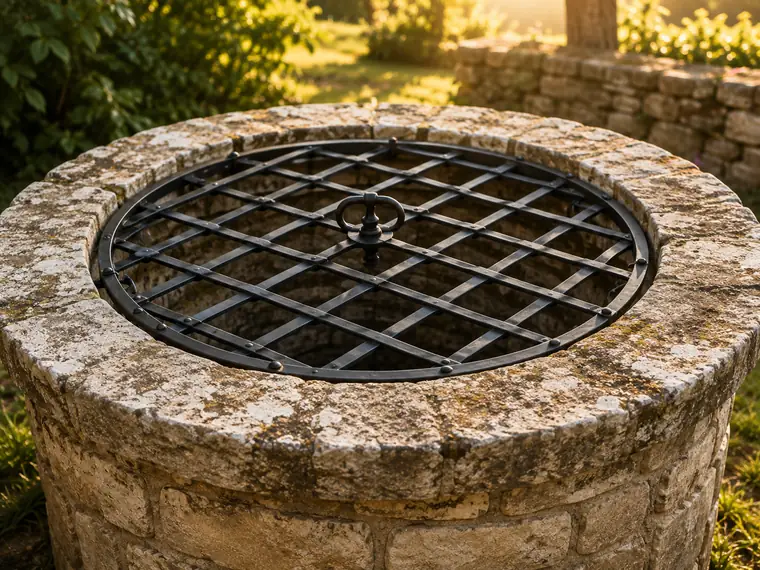
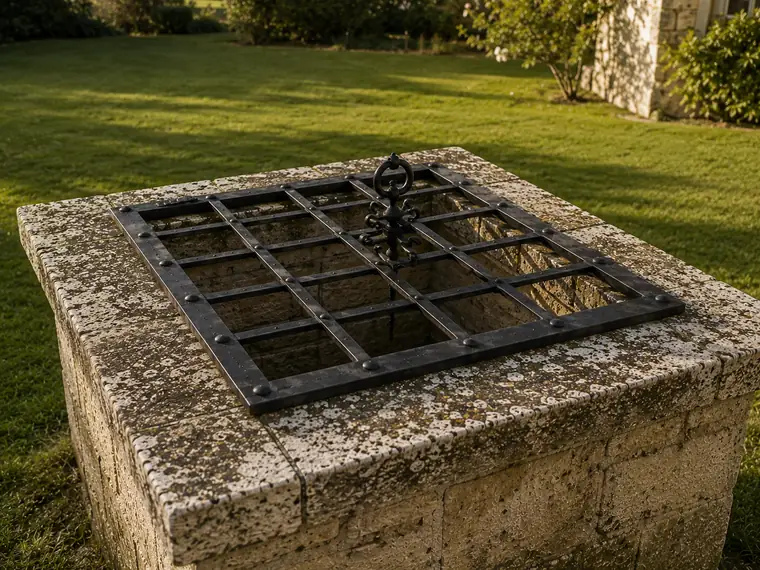
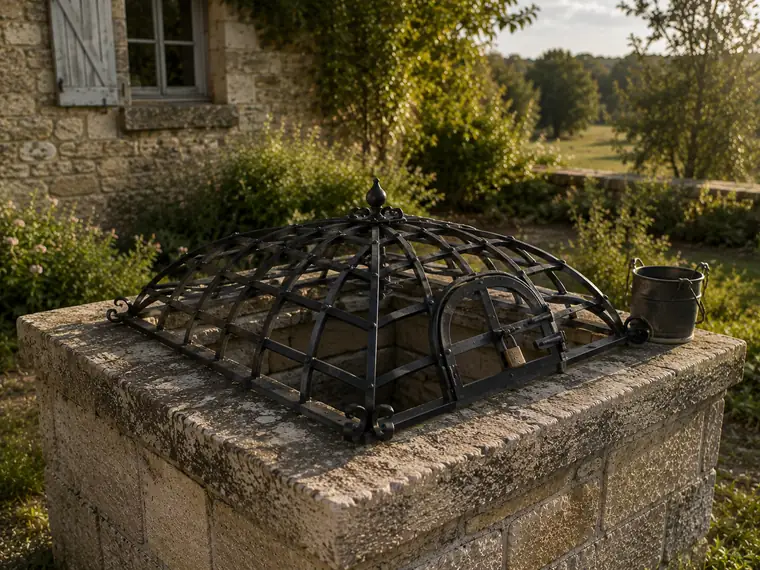
Your domed well cover, quoted within 48 hours
One photo of the well and two measurements are enough. Free quote, 3 to 5 weeks to make, delivered across the EU.
Request my quote