Your well, made safe,
with none of its charm lost
Well covers in solid hot-dip galvanised iron, made to your exact dimensions — round, square, domed or flat, lockable where there are children. Fitted in a morning.
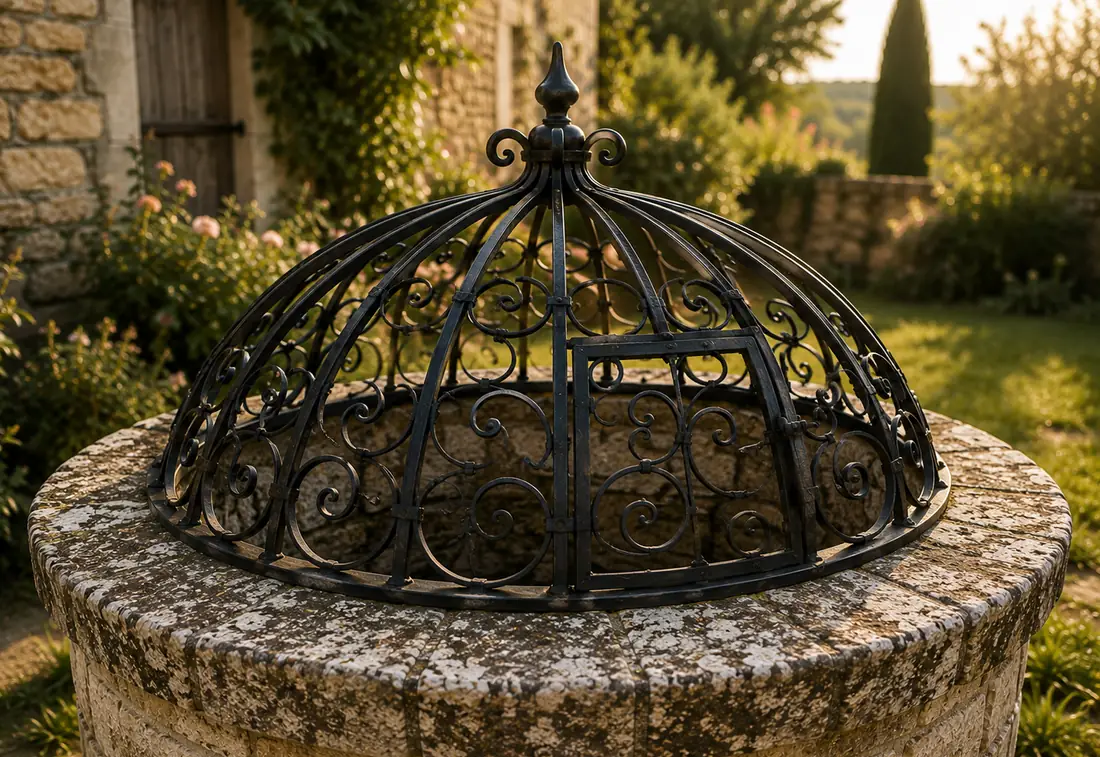
Four shapes, all made to your size
The shape follows the coping and the use: the flat one disappears, the dome crowns, the square one caps built wells, the lockable one protects.
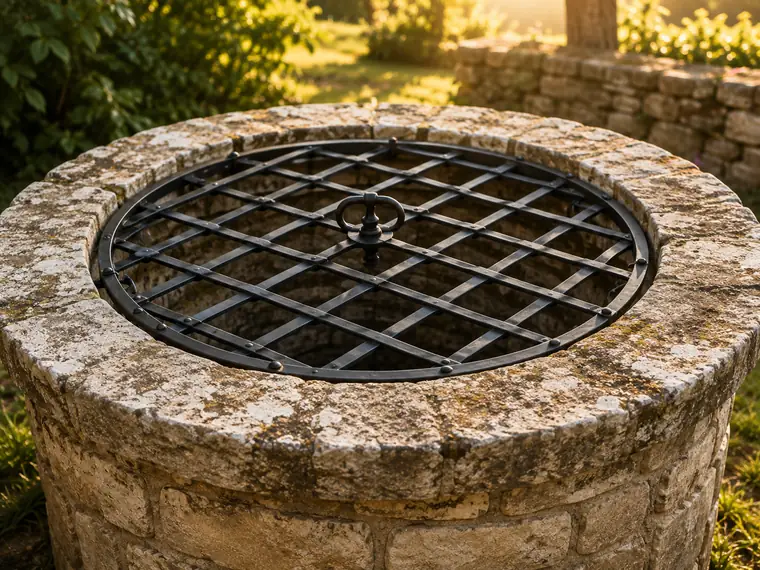
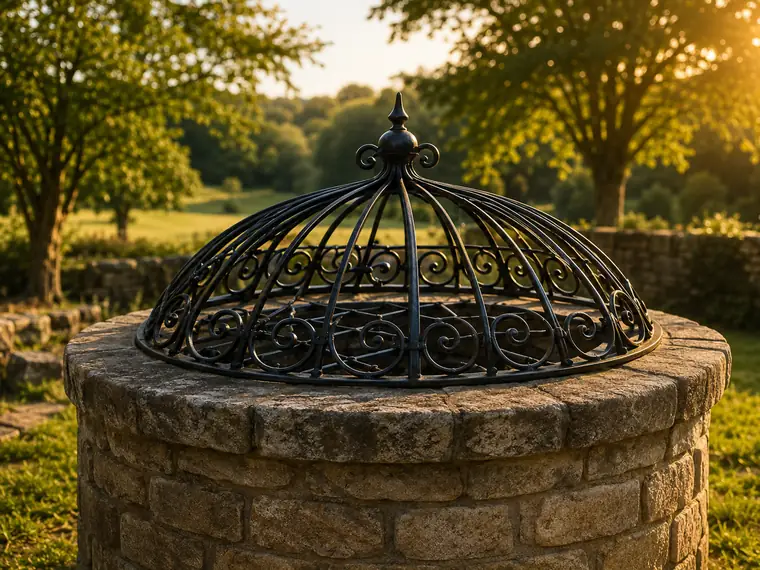
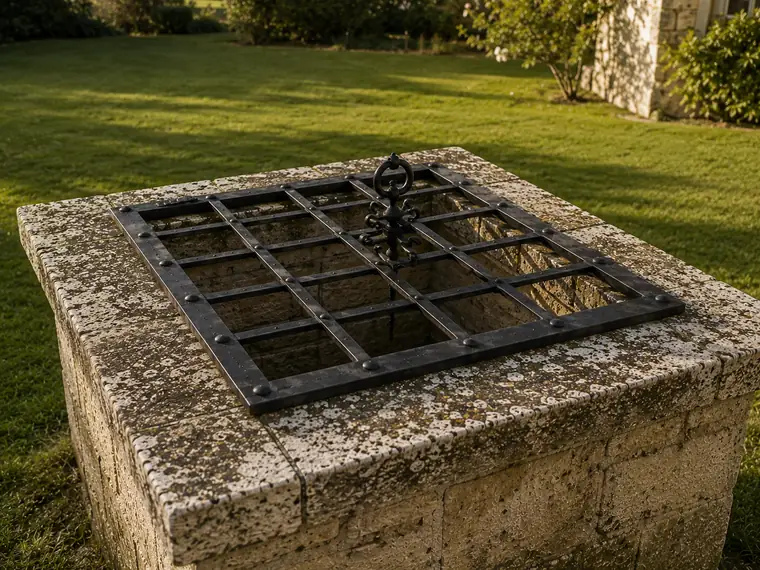
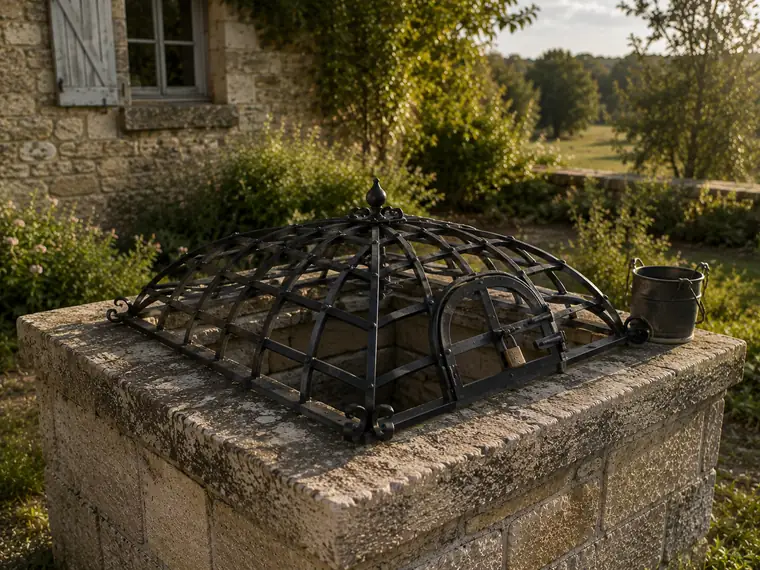
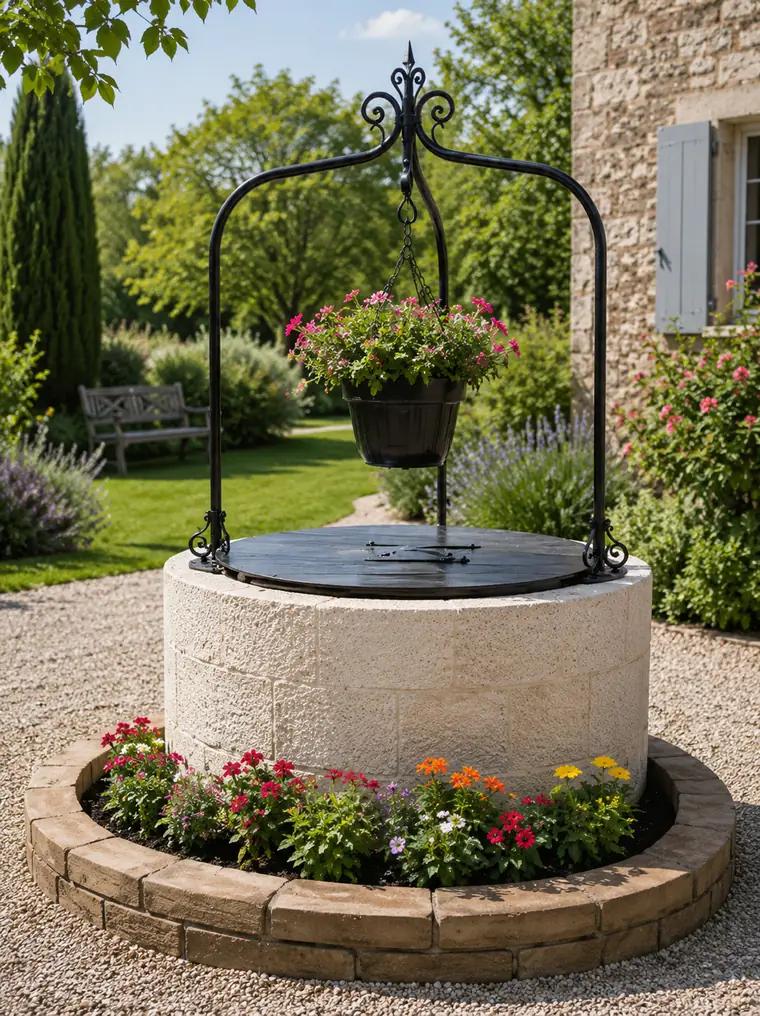
A wrought iron well top, made to measure
“Well top”, “well cover”, “well grille”: the same piece of ironwork that caps the coping, closes the shaft and gives the well back its presence. Solid galvanised iron, rolled to your exact dimensions — flat, domed, square or lockable.
Explore wrought iron well covers →What a well cover costs in 2026
| Model | ⌀ 80 cm | ⌀ 100 cm | ⌀ 120 cm and over |
|---|---|---|---|
| Flat | €440 | €590 | €710 – 920 |
| Square (equivalent) | €490 | €650 | €790 – on quote |
| Domed | €690 | €850 | €1,010 – 1,320 |
| Lockable (any shape) | + €440 | + €440 | + €440 |
Supply prices, June 2026, solid galvanised iron, stainless fixings and paper template included — excluding fitting (€150 – 300, or fixing instructions supplied). Source: Grille de Puits. Full detail on the prices page.
Prices exclude delivery. Delivery is carried out by us and is compulsory: a forged, hot-dip galvanised piece weighing 25 to 60 kg travels on a pallet, not through ordinary parcel post. The cost is quoted with the piece, according to postcode, weight and overall dimensions.
From coping to cover, in three steps
Why cover a well — and why in solid iron
An open well is a real hazard: every year, falls involving children and animals are a reminder that a coping 60 cm high stops nobody. French law places that responsibility on the owner — article 1240 of the Civil Code, liability for things in one’s keeping — and insurers check it after a claim. A sheet of steel bolted down satisfies the law; it also disfigures a well that generations built by hand. An iron cover does both jobs: it closes the shaft, and it honours the stonework.
Solid galvanised iron is the only sensible material in this position. A well cover lives permanently above a column of air saturated with moisture: hollow tube rusts from the inside within a few years with nothing showing, and plain painted steel blisters by its second winter. Ours are forged from solid bar, fully welded, then hot-dip galvanised by total immersion — zinc right into the joints — before painting. That is what underwrites the twenty-year guarantee, and it is why a nineteenth-century well cover is often still in place when the house has been rebuilt three times.
Solid iron versus hollow tube: a gap paid in years
DIY sheds sell “well covers” for forty euros: pressed sheet, or cold-bent hollow steel tube spot-welded together. The arithmetic looks unbeatable — until the third winter. Hollow tube has one fatal flaw in this exact position: its inside. The air rising from the shaft is permanently saturated; it gets in through the smallest weld seam, condenses inside the tube, and corrosion does its work out of sight. By the time rust breaks through the wall, the piece has been dead for a long while. Solid iron has no inside for water to hide in: it is a massive bar, and hot-dip galvanising coats it completely, welds included. Per metre and per year, bespoke solid iron works out cheaper than three cheap covers replaced one after another.
Made to measure, because no two wells are alike
There is no such thing as a “standard” well cover that actually fits, for a simple reason: wells were dug and built by hand, often two centuries ago, without a jig. Two neighbouring wells in the same hamlet share neither diameter, nor coping thickness, nor roundness — most are slightly oval. An off-the-shelf cover, necessarily too big or too small, leaves precisely the gap you were trying to close. That is why every cover we make is rolled to the real dimensions of your coping, taken by you in five minutes and refined by our paper template for irregular shapes. The result follows the stone as though it had always been there — and genuinely closes.
A piece of heritage as much as a safety device
The well is often the oldest structure on the plot — older than the house on many farms. Capping it with a plastic lid erases it from the landscape; fitting a wrought iron well cover puts it back at the centre of the garden. Our four shapes are not an arbitrary aesthetic choice: the flat one erases, the dome crowns, the square one caps built wells, the lockable one reconciles water and children. Our heritage wells page shows how regional forms — Périgord domes, flat Breton crowns, Franche-Comté pyramids — inform our drawings, and our partner Le Fer Forgé documents traditional ironwork in full if your project goes beyond the well.
Well covers: your questions
How much does a made-to-measure well cover cost?
How do I measure my well?
Am I legally required to cover my well?
Do you deliver outside France?
Your well cover, quoted within 48 hours
One photo of the well and two measurements are enough. Free quote, 3 to 5 weeks to make, delivered across the EU.
Request my quote