A wrought iron well cover,
made to your dimensions
The ironwork that closes the shaft and gives the well back its presence: flat, domed, square or lockable — solid galvanised iron, rolled to the exact dimensions of your coping.
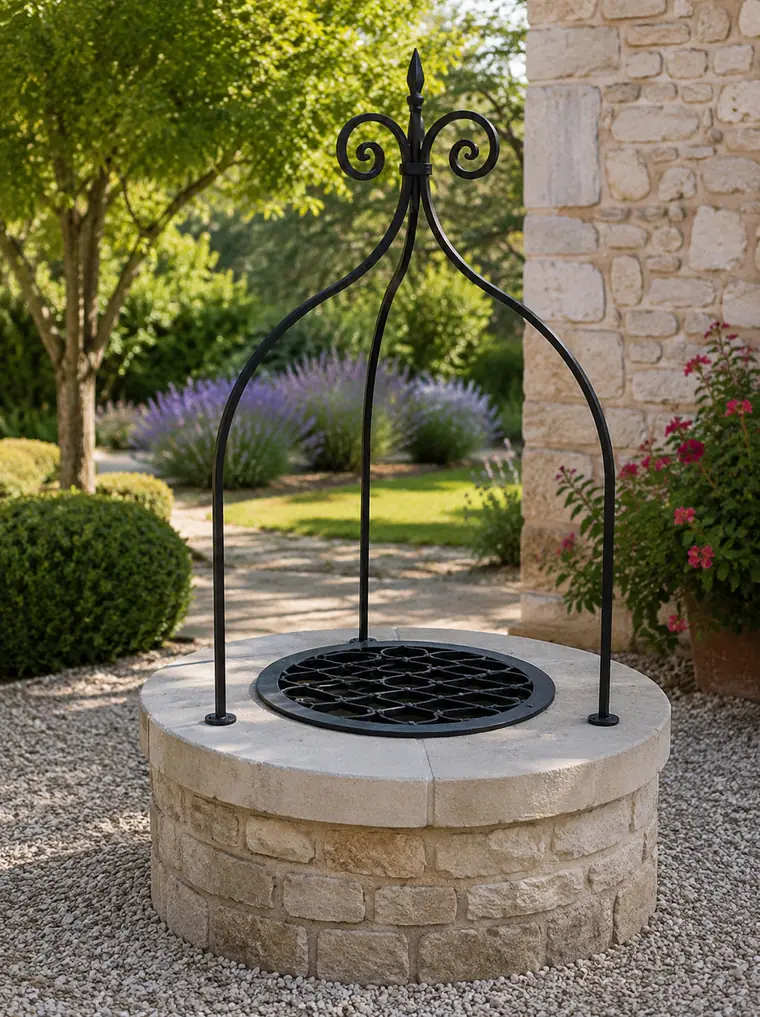
Well cover, well top, well grille: one object, three names
People say “well cover” as readily as “well top” or “well grille”: all three name the ironwork that caps the shaft, stops a fall and gives the well back its crown. The nuance is in the point of view. “Grille” stresses the bars that keep you from falling in; “well top” stresses what you see from the garden — the iron piece that crowns the coping and draws the silhouette of the well. The object itself is exactly the same: a frame rolled to the dimensions of your coping, filled with closely spaced bars, resting on the stone or recessed into it. Whichever word brought you here, you are in the right place.
This page gathers everything to do with well covers in iron and in wrought iron: the shapes available, what those material words actually cover, 2026 prices and how to measure a well that was never round. For the model-by-model detail, each shape has its own page; for a quote, two measurements and a photograph are enough.
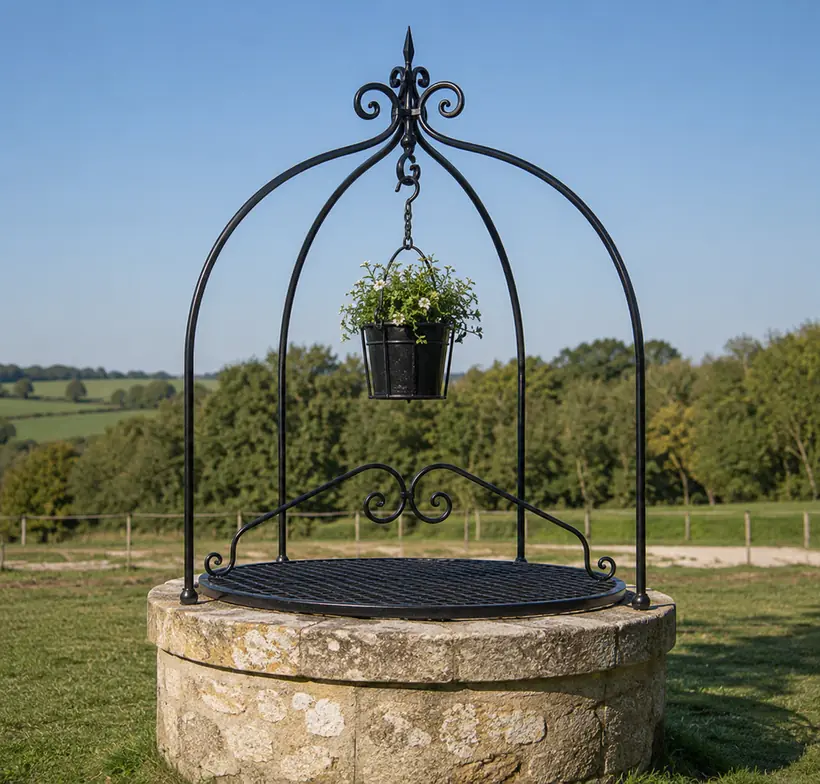
A domed well cover in solid iron: the classic dome of a well with character, closely spaced bars for safety.
Iron, solid iron, wrought iron: what the words really mean
When you search for a “wrought iron well cover”, you are not really thinking about metallurgy: you want real ironwork, not the pressed sheet lid or the hollow steel tube sold for forty euros in a garden centre. Let us be plain. Wrought iron in the strict sense is an old material, all but unobtainable today; the term survives in everyday speech to mean work that is forged — shaped in a workshop, rolled, welded, formed — as opposed to mass assembly.
Our well covers are made of solid iron: massive steel bars, rolled to the exact diameter of your coping, fully welded then ground flush, and hot-dip galvanised by total immersion before painting. That choice is not commercial, it is dictated by the position. A well cover lives permanently above a column of air saturated with moisture: hollow tube rusts from the inside within a few winters with nothing showing, and plain painted sheet blisters by its second season. Solid iron has no inside for water to hide in, and the galvanising coats every joint. That is what underwrites the twenty-year guarantee. Put simply: you are looking for “wrought iron”, and we supply the massive solid iron that keeps its promise — the material that lasts in this exact position.
Four well covers, all made to measure
A well cover only makes sense rolled to your coping: wells were dug by hand, often two centuries ago, and two neighbouring wells share neither diameter nor roundness. Four shapes cover every case, and each is made to your dimensions.
- Flat well cover — Flush and discreet: it makes the well safe without changing its outline. (from €440)
- Domed well cover — The classic dome of a well with character, crowned with scrollwork. (from €690)
- Square well cover — For built wells, inspection chambers and cisterns. (from €490)
- Lockable well cover — A padlocked hatch: the water stays reachable, children do not. (from €880)
The flat one erases the cover from the landscape, the dome crowns it in the manner of manor wells, the square one caps built wells and cisterns, the lockable one reconciles accessible water with child safety. All four share the same specification: solid iron, hot-dip galvanising, twenty-year guarantee, stainless fixings and paper template supplied. Compare the four models →
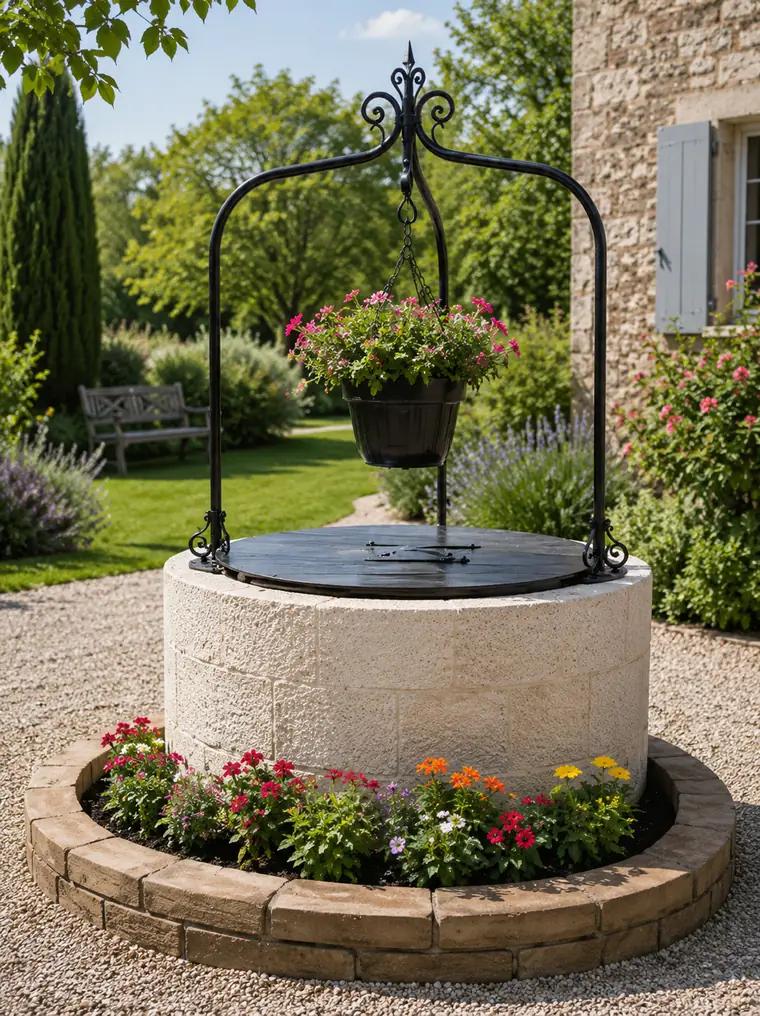
A well cover is what makes the well noticed
The well is often the oldest structure on the plot. A steel or plastic lid erases it from the landscape; a wrought iron cover puts it back at the centre of the garden — it makes the well safe and it signs the stonework. That is the difference between closing a hole and capping a well.
Every cover we make is drawn from a photograph of your well, in the spirit of its region — Périgord domes, Breton crowns, Franche-Comté pyramids. See heritage wells.
What a wrought iron well cover costs
The price depends on the shape and the diameter, never on a fixed catalogue, since everything is made to measure. Here are the 2026 ranges, galvanised supply included, excluding fitting.
| Shape | ⌀ 80 cm | ⌀ 100 cm | ⌀ 120 cm and over |
|---|---|---|---|
| Flat | €440 | €590 | €710 – 920 |
| Square (equivalent) | €490 | €650 | €790 – on quote |
| Domed | €690 | €850 | €1,010 – 1,320 |
| Lockable (any shape) | + €440 | + €440 | + €440 |
Supply prices, June 2026, solid galvanised iron, stainless fixings and paper template included — excluding fitting (€150 – 300, or fixing instructions supplied). Source: Grille de Puits. Full detail on the prices page.
Prices exclude delivery. Delivery is carried out by us and is compulsory: a forged, hot-dip galvanised piece weighing 25 to 60 kg travels on a pallet, not through ordinary parcel post. The cost is quoted with the piece, according to postcode, weight and overall dimensions.
Measuring and fitting a well cover
Two measurements are enough to start a quote: two diameters at right angles across the top of the coping, and the width of the stone. Since old wells are rarely round, a paper template is sent so you can record the real shape — that is what guarantees the cover follows the stone without leaving a gap. Fitting is done with four resin anchors into the coping (never with expansion bolts, which split old mortar): one morning with two people. The full detail is on the measuring page and the fitting page.
Iron well covers: your questions
Well cover, well top, well grille: are they the same thing?
Iron or wrought iron: does it matter for a well cover?
Is an iron well cover always made to measure?
What does a wrought iron well cover cost?
Your well cover, quoted within 48 hours
Two diameters and a photograph of the coping: the workshop sends back a free quote for a solid iron well cover, made to your dimensions and delivered across Europe.
Request my quote